Microfiction Monday – 136th Edition

Made in the Shade
by Brian Beatty
Young women gallivanted around the flea market grounds in skimpy cut-off jean shorts and bikini tops like they were auditioning for nudie bar jobs. Gawping teenage boys followed not far behind. Hurley took it all in from a hammock hanging between two shade trees near his tent full of merchandise. He pretended to be reading a Hardy Boys mystery from his inventory. Kids showed up at sales to be seen, not to buy. You only had to look down at their ridiculous shoes. The women wobbled along on high heels. Their admirers wore bright sneakers fresh out of the box.
Bittersweet
by Fiona Evans
Mum hands me the spoon to lick. The mixture looks disgusting, like gritty brown poo. Chocolate, butter, and sugar whipped up ready for my birthday cake. It tastes like heaven.
She shakes her head and says, “I don’t know how you always look so untidy.”
“It’s my superpower.”
Mum doesn’t laugh. She hasn’t since Dad left. I spread my arms wide and run around the room pretending to fly like superman.
Still no laugh. She just wipes the sweat from her brow and says, “Go on and clean up now.”
Witch
by David Henson
Fingers snap. She’s a grade-school girl, fires apples at the teacher, stops them in midair like a string of beads. A stripper, she wears red balloons she lets the men pop with their cigarettes. When she finishes her act, there’s nothing left but glowing ashes and half-empty mugs. A nun, she dances in the air with a Jesus from a life-sized crucifix as the congregation flees the pews. She enters beauty contests, her talent — dousing herself with gasoline. She strikes a match, while blazing embraces every judge, sits down, and smiles at the screams.
Duty to Protect
When Haruki was drafted into the military, he had accepted death. He’d envisioned a brass bullet whizzing through smoke and blood and shrapnel, puncturing his helmet and splintering his brain, killing him instantly. Instead, one hand of a poacher squeezed his neck, suffocating his screams, while the other thrust a spear beneath Haruki’s ribs, a spear more often used to pierce the endangered eels around the Bemo islands sanctuary where Haruki was deployed, guardian to marine flora and fauna. His last thought was of neglecting his childhood goldfish and his apathy at finding them floating belly up in the water.
Microfiction Monday – 116th Edition

I Never Gave Her a Name
I remember my synthetic baby girl. Like me, a smiling-sad little thing. My childhood doll was a plump thermoplastic form dad had brought home one unusual night. Unusual because he wasn’t in the habit of walking through the door holding little baby dolls in his big hands. He was thrilled I wanted a doll. My first. My only. My younger sister’s flaxen-haired, bow-lipped dollies had never bothered to kiss away my tears. My brown-haired baby doll was beautiful to me, a full-bellied, coffee-eyed friend. I never gave her a name. Then I gave her away.
Grandmother Goose
by David Henson
A golf course snaked around the facility where they cooped the old woman after her name flew away from her. One day she snuck out behind the mail carrier and meandered the fairways and greens, snatching balls — eggs to bake the chocolate cake that once lured family to her home.
A foursome tried to corral her, but she out-maneuvered their carts and crouched among a gaggle by the hazard on seven. When the golfers charged, the birds honked into the sky and wedged away.
They found her housecoat floating in the pond, but Grandmother Goose was never seen again.
No One
by G.J. Williams
There was no Dexter Mahon. He was made up, to account for the sinister edge that entered proceedings. He was never anywhere near. His matter-of-fact approach was the fruit of agonised retellings, each word honed. He’d no link to the lower echelons, no say to speak of. What daylight there was found him out, as it was bound to, of course, there being no such person. He was not even in the shadows.
Microfiction Monday – 107th Edition

Hanging Words
by David Henson
His words hang above the kitchen table even after he leaves for work.
She stands on a chair, grips one of the letters, pulls it loose.
She finds a toolbox. His odor spews from the letter as she files it to a point.
That evening when her husband walks in, she plunges the makeshift weapon into his chest, then calls the police.
One officer examines the husband’s body while the other takes her statement in the kitchen. He notices the hanging words—STUP D COW—and asks about the missing letter. The I couldn’t take it anymore, she says.
The Cure
by Jeannette Connors
Iris routinely sought out seemingly happy people for advice on fixing her mental health disorder. Remedies ranged from a simple ice cream cone to an extravagant African safari. Iris thought those were clearly lactose tolerant people with no fears of a spontaneous wildebeest attack. She always went back to what worked for her though in seeking the comfort of her pet iguana, who neither offered advice nor any inkling he cared about such things.
Boundary Story
by Liz Betz
In the past she’s listened to her friends, a group of women who are always in crisis mode. From their viewpoint they label my behavior as overbearing and narcissistic and place her unhappiness on my doorstep.
Now my wife has discovered she’s an empath that needs special care. She says she has a tendency to put others ahead of herself and that she’s wearing out because of it. It’s draining her energy. From now on she’ll state her needs and there will be accountability for those who ignore them.
Thank you. State your boundaries. I’ve been flying blind.
When Grandpa Stopped Babysitting
It wasn’t when he taught the boy to piss upright and straight-backed in the front yard, staring down disapproving neighbors as they crossed the street. It wasn’t when he wrapped up an airsoft rifle for shooting birds, and gave it to the boy on his eight birthday. It wasn’t even when he taught him how to drive the station wagon, though the boy could only reach the pedals standing up. It was later, when his own name escaped him, when he saw the boy and could only ask, “who are you?” and “why are you here?”
Dear Ophilia
by G.J. Williams
Rue is a strong-scented Mediterranean plant with yellowy-green flowers and pinnately divided leaves. A bouquet of rue, rightly held, will signify sorrows endured, depths of loss untold. Marigolds and fennel won’t do. Violets daisies carnations ditto. And forget roses. But scatter petals of rue as you go and the world smiles wanly with you. True, there’ll be a curtain-twitching aspect to contend with but, all in all, your going hence will be accorded the flourish of a dance. Strew those petals, mutter those barbs, give what lives the finger. Rue the day, the very sunlight’s touch.
Hands of Time
by James Dupree
She holds his hand in hers and wonders how something so extraordinary can be so small. Growth is slow, but time is slippery. Years feel like moments to her, and his hand begins to fill her palm, threatening to break their bond.
Fingers continue to extend, and muscles grow stronger, and before she can ready herself for this inevitable change, his hand matches hers in size. She watches her own hand shrink till the skin sags around the bones. His hand begins to overtake. He holds her hand in his and wonders how someone so extraordinary can become so small.
Microfiction Monday – 105th Edition
This week’s artwork is “Lotus” by Shadowlance

The Fates Watching Over John Henry
by David Henson
Tonight, John Henry, you’ll come no closer to sleep than watching it raise and lower your Lucy’s breasts. You will not understand why the moon weeps through the window and oils your shoulders for tomorrow. Why, this night, the stars seem heads of silver spikes only you can drive into the sky.
You carefully untangle straw that has leaked from the mattress into Lucy’s hair. We’ll leave after we grant you a snagged curl to awaken her.
But, John Henry, we must return when dawn hammers the horizon.
Whispered Echoes
by Nicole Burton
When they would listen to her no other way, Echo learned to whisper in the ears of the pale-skinned gods who sat around boardroom tables. “You always have the best ideas,” she whispered to Pride when she took his coffee order. “If you invest, the company could never fail.”
Every day, she whispered daffodil words to him, and he unknowingly echoed her praise as if it were his own. “I think we should invest.”
Every day, she ran his errands and watched him turn her words into skyscrapers and gold, knowing they would never be hers.
Rich Man
by Phil Trafican
Once there was a rich man who walked with a limp. His town folk wanted to be rich, too and copied everything about him that they could. So, of course, every man, woman, and child began to walk with a limp. Even the dogs were hobbling around.
But then the rich man hired doctors who cured him of his limp. He could now walk fine while everyone else still limped for they had forgotten how to walk the right way and could not afford doctors. In the meantime, the rich man got even richer selling the town’s people crutches.
Bar Open
by Jago Furnas
Late in an empty dive bar, a beautiful girl hands your arse to you over the pool table and drives you home on the wrong side of the road with Donna Summer’s ‘I Feel Love’ blasting. Any pre-emptive performance anxiety is replaced with survival anxiety, which is kind of liberating. She makes sudden stops to roll cigarettes every few hundred meters. The two of you will laugh about this in ten years on the porch of your weatherboard house in Thornbury, as you make sure your beautiful kids have their helmets on before they ride their bikes around the block.
Untouchable Angels
by DS Levy
Standing at his locker, he hears firecrackers and sees Billy Evans in his black trench coat. He touches his chest; his fingers, smeared in blood. Unlike the movies, he feels nothing—until he does, a searing spasm. The light fades as handfuls of Luna moths flutter out of his chest, wingtip-to-wingtip, and he hears Mr. Lewinski, his biology teacher, saying how they spend two weeks as eggs, six to seven weeks as larvae, and nine months as pupae before emerging as beautiful lime-green bodies, big as small plates with moon spots, and live for one short, but glorious week.
How It Was
by G.J. Williams
It’s so cold the stone weeps. Write that down, comrade; it’s all in the detail. It was so cold the stone wept. Walls. Put walls down too. Walls weep. It was so cold the walls wept. That’ll be us, comrade. It’s the tale they’ll tell. Make a note. How the walls wept, how the stone ran, as winter closed in. And how it was the writing hand turned blue. And wolves, don’t forget how we heard the wolves. We’ll hear them soon enough. Let it be known it was their call we died to. Make the moon full.
Time
A serpent wraps back on itself and starts to swallow its tail having decided it was unhappy with how it got to where it was. It thought, “I’ll start here and eat my way back to the beginning so I can start all over again. The tail disengaged and wrapped itself around the head saying, “I’ve already seen the end and don’t want to sit through the movie again from the beginning.” The belly, sitting quietly in the middle of the conflict, laughed content to eat what was served.
Microfiction Monday – 103rd Edition
This week’s artwork is by Christine Duncan.

Even Though I Don’t Believe in Such Things
The room is ghost white then black again and the sky cracks with such violence the bed frame shakes. The rain thwacking wet against the glass sounds as if God himself is throwing drumfuls of it. The dog whines like she is heartbroken we deserve such punishment. She buries her nose under my feet, coveting more of the duvet from my side despite the neat, empty plentitude on yours. She’s still waiting for you. And even though I don’t believe in such things, if there was a night for ghosts, this would be it.
The Loved Ones
by Pratik Mitra
The under construction skyscraper could be seen from her slum. Lockdown delayed it’s work. Nights were still left to stay dark and mornings echoing with birds’ chirp. Things would change soon into a cacophony of halogen lights, metallic clanks, and screaming of exhausted men. She wondered while peeing just outside her hut under open sky for how long that pee would be able to go and fall into that disputed marshland on which the skyscraper was being built up. The only thing that she loved besides her body was that marshland and yet…
Fight
by David Henson
As we drive through the Illinois farmland we pass a coyote sprawled roadside I want to pull over get out pick up the broken teeth rattle them shout this is all you’ll ever hear from me we might as well put our lips to this growl only the asphalt can hear exhale the last breath of our marriage over this slab of tongue and into the flat sacks that were lungs and call someone to haul this poor beast away.
But a dead coyote’s a blink at sixty. We have more to do with the corn.
Modern Romance
by Angelo Aita
He was infatuated with her when they first met, but as soon as they slept together he pulled away, though not before he said he’d love her until the world exploded, which was not technically a lie; and although she didn’t much like him, she became obsessed with his pulling away, i.e., reading into the late-night text messages he’d send (seemingly at the precise moment she’d begun to accept his pulling away) in hopes of continuing their sleeping together at an emotional distance he was comfortable with, ad infinitum.
After Her Daughter’s Suicide
by Molly Clark
She burned the dinner. She had spent hours preparing it, chopping the vegetables, caramelizing the onions, marinating the meat. She was responsible for feeding her family and the failure burst out of the fire extinguisher with a blast of cool death. A finalizing air. Her husband was disappointed; the party was ruined. Everyone went out to eat instead; they needed a meal she couldn’t destroy. She stayed home and scrubbed the pan.
Lost Riposte
by Ana Gardner
On opposite sides of the Atlantic, two titanic women played ping-pong with a little girl.
“You can have her this summer,” said one woman, paddling the girl across the ocean with a backhand spin.
The other paddled back. “Take her for Christmas, but I want her back in January.”
A serve went awry, once: the little girl fell in the ocean and swam by herself, in any direction she pleased, and she never wanted to go back.
Microfiction Monday – 100th Edition

Foreseen
by Voula Labos
She saw herself in New York City.
Sawing through the moving bodies, toward her destination, coffee cup in hand, mint suede shoes, try to not get stepped on, nearly unavoidable at 7:54 on a Monday morning, but it was all in the attempt.
The rain, the shoes all muddied, coffee spilled, burning, and she was two and a half minutes late but it was New York and not okay but half expected and was what you had to do to be a part of the city and she’d gladly trek through quicksand to continue with this life.
Unvisible
by Kent Oswald
Never believing his mother’s repeated reassurances he was just a late bloomer, Mark had always regretted what seemed a burden of terminal normalcy until the day he hid from work in a toilet stall and timed himself reading Victor Hugo’s “Les Miserables” for an hour and three minutes. Thinking “who else would do that?” he resumed his accounting with unbridled optimism, unaware—and finally with no concern—that nobody else noticed nor cared.
Under The Eight-Mile Bridge
by DB Cox
Most nights he slept in the silent space between freights that rolled overhead like a storm. Rocking concrete pillars planted along hidden fault lines—under the eight-mile bridge. Where gods spoke through broken wine bottles and drunken-tongued stumble-bums coughed up old tales that colored the air blue. Haunted faces, like hopeless ghosts, tallying old mistakes under the eight-mile bridge.
His mind was gone when they brought him back to the county home—where he lies under nights too quiet staring up, restless and confused, wondering what happened to the thunder under the eight-mile bridge.
Clutter
Dish towers sway beside ornithology magazines; a shoe gathers mold in the sink. He tries to be better, like a skunk trying to fly. Junk-winnowings, selective, sparing more than he trashes. Useful items, never used. Still, mail lurks in the bathroom, pamphlets avalanche the unwary—his wife mourns old checks, dated 30 months prior—artifacts from the past, never cashed.
“Let’s see a couple’s therapist,” she says. They don’t. Instead, when they drive to the city two years later, it’s to meet a divorce lawyer, who draws up the paperwork her husband later shoves into the gap behind the sofa.
Silver Years Self-Discovery
by Laxmi Vijayan
Didn’t have the cash nor the courage to leave country, so I kept my ‘Eat, Pray, Love’ near Virginia. My granddaughter says local is en vogue.
I ate my way to my stomach, and through its lining, at them Korean places? It was authentic cuz none o’ them understood a word I said.
Y’know, I meant to find God at that temple in West Virginia. But He wasn’t worth driving through 200 miles of mountain roads, so I settled for Buddha at Luray Caverns.
At my age, I can find love right here, playin’ board games at the Senior Center.
Goodwill Thrifting
by Maggie Childers
Oh, who am I when I listen to vinyl? My old boorish vinyl—the stories behind these records must be rich and telling! Oh, who am I when I gingerly flip through these stories, pressing them onto my player? Some 70’s song playing intricately in the background, surely the soundtrack to a movie! A glimpse into this room is a glimpse into a cinema. A film of a girl with a record player plays under stars, under bed comforters, under parents’ arguments. She believes in this song. This dance. This subtle nod at all that’s happy. Amongst a wretched summer.
Corona
by David Henson
She dreams moonlight turns to frost in his lungs, and he scrapes his breath from the mirror when he shaves, coughs up hail.
His shivering awakens her, his body spooned to hers. She piles blankets. So cold, he says, darkness separating him from his voice. A shiver slithers up her spine. She tries to make her thoughts July.
After he’s gone, she looks through memories on his phone, finds a photo of herself standing near the water, whitecaps riding her shoulders. Her face is shadowed, and her head blocks the sun, its light flaring through her hair.
Cynic
by Yash Seyedbagheri
Cynicism never abandons you.
It’s easy to laugh at smiles and contemplate what pills people take to induce jocundity.
It’s even easier to laugh at Mercedes and BMWs, imagine that some so-called family man is compensating for extramarital affairs. He doesn’t know his kids’ favorite bands or wife’s worst days.
It’s very easy to dissect Leave It To Beaver reruns.
Ward’s beating Wally and Beaver off-screen. June plans to abandon them, plans disguised within starched smiles and nicknames.
At dusk, I absorb long bursts of tangerine, pale blue, and lavender. I almost smile.
But there are layers beneath clouds too.
Microfiction Monday – 93rd Edition
This week’s artwork is “Piety and Supplication, With Fishes, Sharks and Letting Agents” by Julian Cloran.
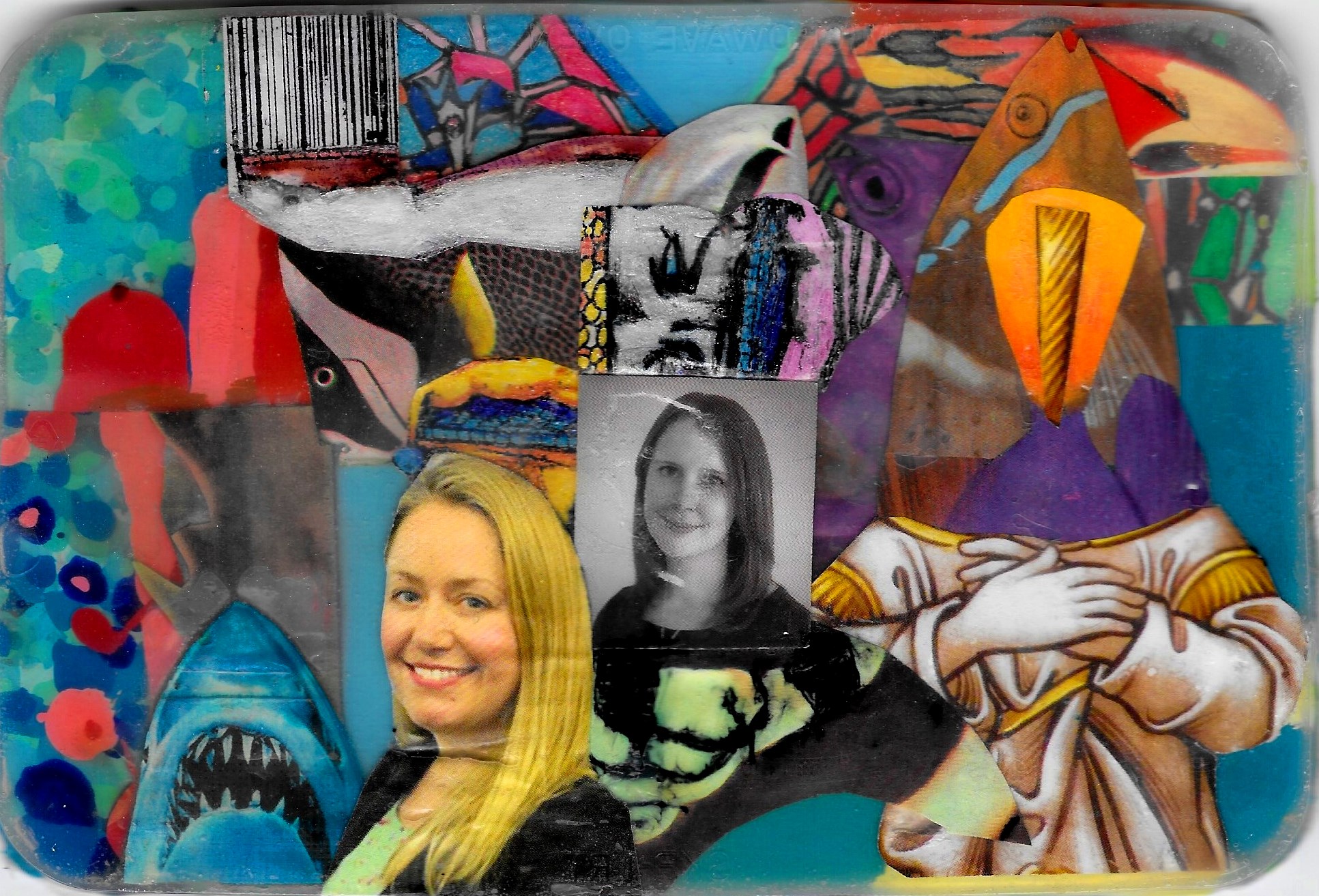
Katie Anne Dour’s, Tiny Family Snow Globe
by Dan A. Cardoza
She’s conflicted. If she insists the lights off, will that be seen as a compromise? Katie won’t be punished for sleeping in layers of sweat-soaked bedclothes and blankets. Mother is aware she’s not a sweet Vidalia onion. Sure she’s upset about school grades and fighting. They call her Sour Lemon Dour. But, that’s not the reason. Katie will be punished for making it snow all night. Mother says, “How dare you expect a perfect summer with all that white noise?” There’s not a vengeful bone in her body. There are none. Katie Dour is a delicate, porcelain dolly.
Sunflowers
by Calvin Yorick
The gray beast is gnarled all over like dead bark. It sits in the sky over moonlit ruins and the tattered masts of shipwrecks. It sings. Branchlike limbs swings concentrically in a silent dance, and a great, tangled head quivers in a gentle orbit away from the rising moon, humming softly. Electrically. We fall to fatigue; this ghastly birdsong bids us to sleep. And in dreams overgrown with sunflowers we wake to the firelit shores of an empty city, waiting eternally for morning and the inevitable nightmare which follows.
Mr. McKonkie
by David Henson
A tattoo battleship plowed the gray on his chest. He hoisted an anchor on each arm. An eagle stretched from wing to wing of his shoulders.
One day we found a blacksnake. He grabbed a hoe, and we chose between watching the body flop in the grass or his cat eating the head in his lap.
After his wife died, he spent every evening in an old caned chair, told us he let the stars fly out of his eyes to their places.
That last night he surprised us when he laid back his head and flew out with them.
Overdramatic
by Abigail Skinner
She laughed.
I stood there, feeling the crisp breeze prick against my open and exposed heart. And she laughed.
“Right,” I said. I snapped my ribs back into place and tugged at the muscle. Slipped back into my skin. “Heh, you’re right.” Covered now, but not enough. The wind still cut through. I threw on a shirt.
She chuckled. I kept adding layer after layer. A sweater. A flannel. A hoodie. A coat. Finally, a windbreaker. Too late. The wind was already inside me, the chill deep to my bones.
She sobered. “Wait, were you serious?”
I laughed.
Gone for a Song
by Simon Barron
From his lofty banyan perch, a honey-creeper struck up in joy and expectation, for the time was ripe. Notes fell like diamonds sprinkled on the air. Swelling, he pushed the gallant question further.
The island, bounded by sullen seas, gave no like return. Yet there was life enough, with furtive cats and sportive rats and braying goats in pens.
Another interloper – a solitary ecologist – sat on a log-pile near the banyan and wept to hear the exquisite song fall about her. She knew what the honey-creeper couldn’t.
He sang all day, and never so well.
Frozen Here
by Roger Haydon
From the other side of the ornate doorway, I thought I saw a house with open shutters, lights on and smoke curling from chimneys. I heard voices, saw figures talking and laughing, saw a manicured garden, neat lawns and bright flowers and children playing. And then, eagerly, I stepped through.
Now, standing in a shell of scarred walls pierced by empty windows and vacant corridors, the fine rain turns the rubble to mud and tears sting my cheeks. I can see sunlight on the other side but don’t know if I can go back or if I should even try.
 Microfiction Monday Magazine